Wheeled locomotion is the most widely used method to date due to its high energy efficiency and ease of control
(e.g., Lunokhod-1 [Moon, 1970], Lunokhod-2 [Moon, 1973], Sojourner [Mars, 1997], Spirit & Opportunity [Mars, 2004]).
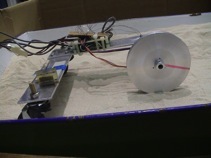
However, wheeled rovers face the risk of slipping on loose soil.
This risk is particularly significant on the lunar surface, which is covered with regolith — extremely fine particulate sand.
Our laboratory studies terramechanics, the interaction between the rover and soil, to develop stuck detection and avoidance systems that enable safe traversal on such terrain.
Hopping Rover
On celestial bodies with very low gravity, such as asteroids, wheels and legs cannot generate sufficient ground reaction force for effective locomotion.
Therefore, hopping rovers have been proposed for such micro-gravity bodies (e.g., MINERVA [Asteroid Itokawa, 2005 — landing failed]).
However, if the landing attitude is unfavorable, subsequent hops may become impossible.
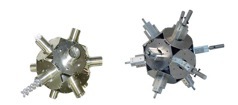
Our laboratory studies hopping rovers with three-dimensionally isotropic body shapes that can tolerate any landing attitude.
Walking Rover
Traversing highly uneven terrain is difficult for wheeled rovers, so previous rover missions have been limited to relatively flat areas.
Legged rovers are expected to perform better on such terrain by stepping over obstacles.
However, lifting legs can cause loss of balance and tipover, requiring complex control algorithms.
Additionally, soft and fragile soil can suddenly deform or collapse, making complete tipover avoidance impossible.
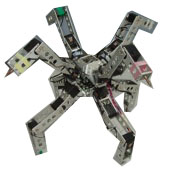
Our laboratory studies walking rovers with legs attached at three-dimensionally isotropic positions around the body center, effectively eliminating the concept of tipover.
We aim to develop locomotion algorithms that allow the rover to autonomously generate walking patterns adapted to the terrain.