Research
Current research topics
Graduate school
\begin{align*}
{\rm Ising\; model:}\quad & E(\{\sigma_i\}) = \sum_{i} h_i \sigma_i + \sum_{i < j} J_{ij} \sigma_{i} \sigma_j, \quad \sigma_i \in \{-1,1\} \\ \\
{\rm QUBO:}\quad & E(\{q_i\}) = \sum_{i} \sum_{j} Q_{ij} q_{i} q_j, \quad q_i \in \{0,1\}
\end{align*}
Quantum annealing computers are specialized for solving combinatorial optimization problems where a cost function expressed in the form of an ising model or QUBO is minimized.
Quantum annealing algorithms have been actively developed and studied in information science, but they have hardly been applied to the field of fluid dynamics.
Understanding quantum annealing algorithms enables an entirely different approach to realize flow computations, shape optimization, and machine learning.
Although the performance of quantum annealing computers themselves is still in its infancy, we regard quantum annealing computers as one of the next-generation computers and are engaged in research on the applications of quantum annealing computation to the fluid dynamics field.
量子アニーリングコンピュータはising modelもしくはQUBOと呼ばれる形で表現されるコスト関数を最小化する組合せ最適化問題に特化したマシンとなっている. 量子アニーリング計算に関する研究・開発は情報科学の分野で盛んに行われているが,流体力学分野への応用はほとんど見られない. しかし量子アニーリングアルゴリズムを理解することで今までとは全く異なるアプローチで流体計算や形状最適化,機械学習が可能となる. 量子アニーリングコンピュータ自体の性能もまだまだ発展途上ではあるが,量子アニーリングコンピュータを次世代の計算機の一つとして捉え,量子アニーリング計算の流体力学分野への応用に関する研究に取り組んでいる.
[Kuya et al., CaF, 2024; Asaga & Kuya, CaF, 2025]
量子アニーリングコンピュータはising modelもしくはQUBOと呼ばれる形で表現されるコスト関数を最小化する組合せ最適化問題に特化したマシンとなっている. 量子アニーリング計算に関する研究・開発は情報科学の分野で盛んに行われているが,流体力学分野への応用はほとんど見られない. しかし量子アニーリングアルゴリズムを理解することで今までとは全く異なるアプローチで流体計算や形状最適化,機械学習が可能となる. 量子アニーリングコンピュータ自体の性能もまだまだ発展途上ではあるが,量子アニーリングコンピュータを次世代の計算機の一つとして捉え,量子アニーリング計算の流体力学分野への応用に関する研究に取り組んでいる.
[Kuya et al., CaF, 2024; Asaga & Kuya, CaF, 2025]

Upwind schemes, which contain numerical viscosity, are commonly used to perform flow computations stably.
However, when upwind schemes are used, it is difficult to perform high-fidelity flow computations due to the non-physical effects of numerical viscosity.
We have developed stable and non-dissipative (i.e., no numerical viscosity) numerical schemes, kinetic energy and entropy preserving (KEEP) schemes.
Many problems still need to be solved in applying high-fidelity flow computations in the design of industrial aerodynamic systems.
We are developing novel numerical methods for flow computations to solve those problems.
流体の数値計算を安定に実施するには数値的な粘性が付加された数値計算手法 (upwind scheme) が一般的に用いられる. しかしupwind schemeを用いた場合には,非物理的に付加された数値粘性の影響で高忠実に数値計算を実施することが困難となる. そこで我々は数値粘性の付加なく安定な数値計算手法 "kinetic energy and entropy preserving (KEEP) scheme" を構築した. 産業分野において高精度流体計算を流体機械設計に常用出来るようにするにはまだまだ課題が多く残されており,それらの課題の解決に向けて新たな数値流体計算手法の構築に取り組んでいる.
[Kuya et al., JCP, 2018; Kuya & Kawai, CaF, 2020; Shima et al., JCP, 2021; Kuya & Kawai, JCP, 2021; Kuya & Kawai, JCP, 2022; Tamaki et al., JCP, 2022; Kuya et al., JCP, 2023, Kato & Kuya, JCP, 2025]
流体の数値計算を安定に実施するには数値的な粘性が付加された数値計算手法 (upwind scheme) が一般的に用いられる. しかしupwind schemeを用いた場合には,非物理的に付加された数値粘性の影響で高忠実に数値計算を実施することが困難となる. そこで我々は数値粘性の付加なく安定な数値計算手法 "kinetic energy and entropy preserving (KEEP) scheme" を構築した. 産業分野において高精度流体計算を流体機械設計に常用出来るようにするにはまだまだ課題が多く残されており,それらの課題の解決に向けて新たな数値流体計算手法の構築に取り組んでいる.
[Kuya et al., JCP, 2018; Kuya & Kawai, CaF, 2020; Shima et al., JCP, 2021; Kuya & Kawai, JCP, 2021; Kuya & Kawai, JCP, 2022; Tamaki et al., JCP, 2022; Kuya et al., JCP, 2023, Kato & Kuya, JCP, 2025]
Undergraduate school
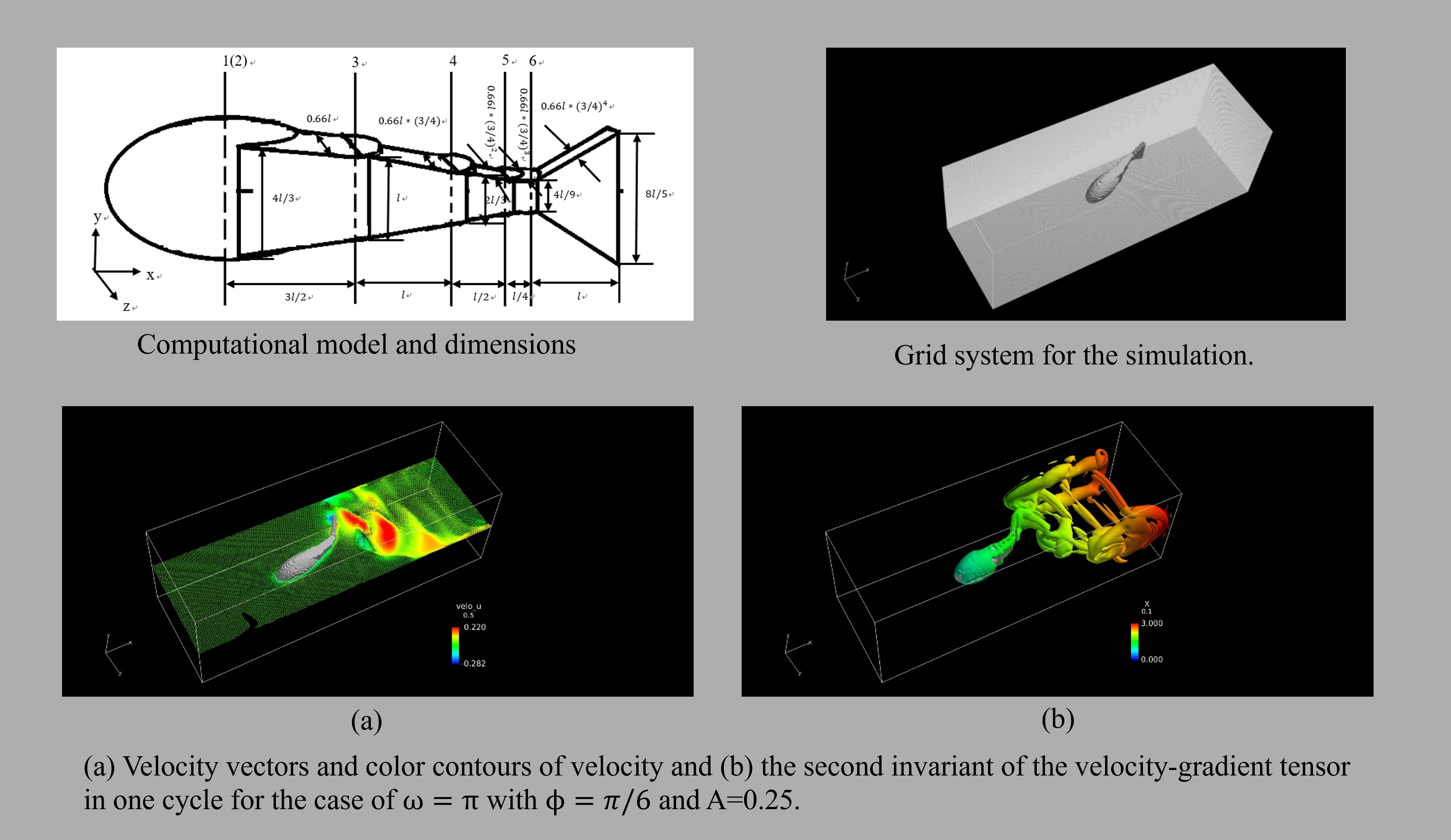
In this study, a three-dimensional simulation of a fish-like body swimming in a channel with non-slip walls was carried out to investigate the effects of kinematics on swimming performance.
Selfpropelled swimming in an inertial coordinate system was examined by using the direct forcing immersed boundary method.
The fish body consisted of several rigid bodies and behaved analogously to a multi-segment robotic fish.
The computational program was first validated by simulating fluid flow around a circular cylinder at Reynolds number (Re) =100 and Re = 1000, as well as around a settling particle.
The results were compared with experimental and numerical results from past research in the area.
A virtual parametric study of the tail-beat frequency, phase difference between neighboring body segments, and body amplitude was then conducted.
The effect of the lateral and vertical distance between the model body and walls on swimming performance is also discussed.
The results for the velocity and vorticity fields around the model body provided evidence for the mechanism of thrust generation and highlighted the effects of kinematics on swimming performance.
一般的なCFD(Computational Fluid Dyanamics)では物体の形状があらかじめ決まっており、それに対し流れ場を解く事をしている。 immersed-boundary法では厳密に形状に合わせた格子を作成することなく計算を行うことで形状変化を伴うようなシミュレーションも比較的簡単に行うことが出来る。 物体が流体から力を受けたり、また逆に流体に対して力を与えたりすることを時々刻々と形状が変化するような場を格子の変更を伴うことなくシミュレーションを行った。 ここでは魚のような形状のものが小さな水槽の中を泳ぐ様子をシミュレートした。
[Y. Zhang et al., Engineering Applications of Computational Fluid Mechanics, 2018]
一般的なCFD(Computational Fluid Dyanamics)では物体の形状があらかじめ決まっており、それに対し流れ場を解く事をしている。 immersed-boundary法では厳密に形状に合わせた格子を作成することなく計算を行うことで形状変化を伴うようなシミュレーションも比較的簡単に行うことが出来る。 物体が流体から力を受けたり、また逆に流体に対して力を与えたりすることを時々刻々と形状が変化するような場を格子の変更を伴うことなくシミュレーションを行った。 ここでは魚のような形状のものが小さな水槽の中を泳ぐ様子をシミュレートした。
[Y. Zhang et al., Engineering Applications of Computational Fluid Mechanics, 2018]
Flow field around a car
In general Computational Fluid Dyanamics (CFD), an object is fixed and the state of the fluid around the object is calculated.
When the object is in motion, the calculation is performed by changing the attitude of the object with respect to the flow field.
In the non-inertial system, the motion of an object in a fluid is simulated by moving the object in the flow field to represent the object in motion relative to the flow field.
一般的なCFD(Computational Fluid Dyanamics)では物体が固定されており,その周りに流れる流体の状態を計算している. 物体が運動をすると流れ場に対して物体の姿勢を変化させて計算する. 非慣性系では,流体中において物体が運動するさまを外力等で反映させることで,疑似的に流れ場に対し物体が運動している状態を表現する.
[, , ]
一般的なCFD(Computational Fluid Dyanamics)では物体が固定されており,その周りに流れる流体の状態を計算している. 物体が運動をすると流れ場に対して物体の姿勢を変化させて計算する. 非慣性系では,流体中において物体が運動するさまを外力等で反映させることで,疑似的に流れ場に対し物体が運動している状態を表現する.
[, , ]