
Heat and Energy
in Aerospace Engineering
In our laboratory, we pursue a new world
where heat and energy are intelligently controlled and harnessed,
with “nanomaterials,” “phase interfaces,” and “MEMS technologies”
as our key research keywords.
Thermal and energy-related technologies have long been essential in aerospace engineering—and their importance is growing even further today.
In space, where there is virtually no “heat sink,” advanced thermal control is indispensable to keep spacecraft such as space stations and satellites within safe temperature ranges.
On Earth, toward a carbon-neutral society, intensive efforts are underway worldwide to develop hydrogen-powered aircraft and electric aircraft.
In these next-generation platforms, practical implementation will critically depend on thermal management of hydrogen fuel systems, batteries, and electric motors.
Energy self-sufficiency is also a central challenge for isolated environments such as space.
Beyond improving the performance of solar cells and fuel cells, there is a constant demand for novel power-generation concepts that effectively utilize waste heat and surrounding environmental energy.
Nanotechnology is a major driver of innovation in controlling and utilizing heat and energy.
In our laboratory, we experimentally investigate fundamental yet unresolved problems in heat transfer, fluid mechanics, and energy engineering—especially heat and mass transport at nanometer scales—by combining MEMS-based devices and sensors with lasers and advanced microscopy/measurement techniques.
Research Highlights
・Thermophysical property measurements of low-dimensional and nanostructured materials (e.g., 2D materials)
・Nanoscale observation and characterization of phase interfaces (solid–liquid, liquid–vapor, etc.)
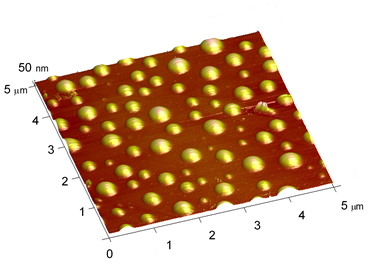
Our current research is focused on experimental elucidation of unsettled problems about heat transfer and fluid mechanics, especially nanometer-order heat and mass transport problems, by means of MEMS technology, laser and advanced microscopies.
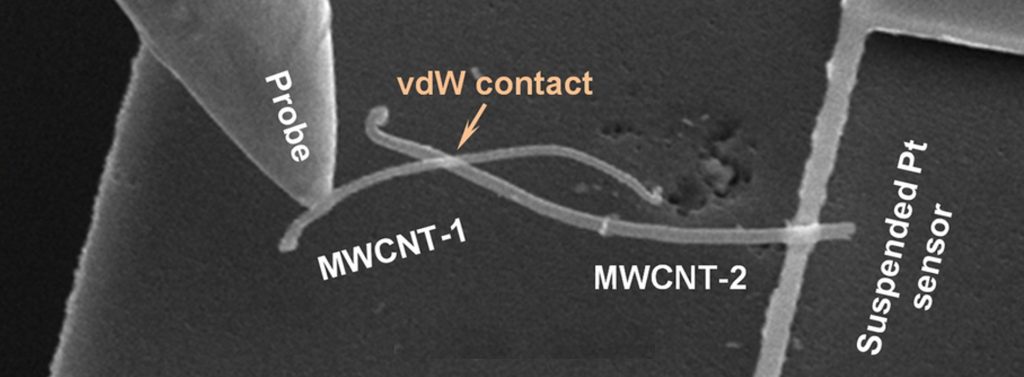
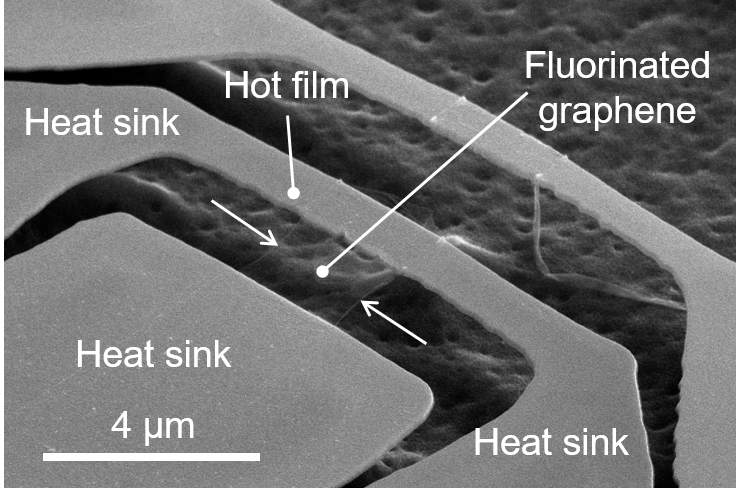
For example, using sensors designed and fabricated in our laboratory, we can measure the thermal conductivity of individual nanomaterials with characteristic sizes below 100 nm. We also evaluate interfacial heat transfer (thermal boundary resistance) between nanomaterials and substrates using Raman-based methods.
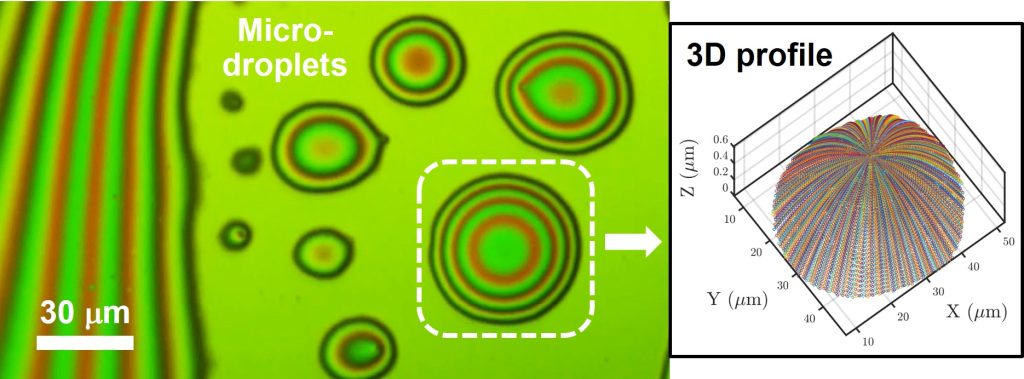
It is well known that when the size of a solid material is reduced to the nanometer scale, its physical properties can change dramatically—and this is also true for fluids. Motivated by this, we investigate the properties and underlying physics of nanoscale droplets and bubbles, including nanobubbles.
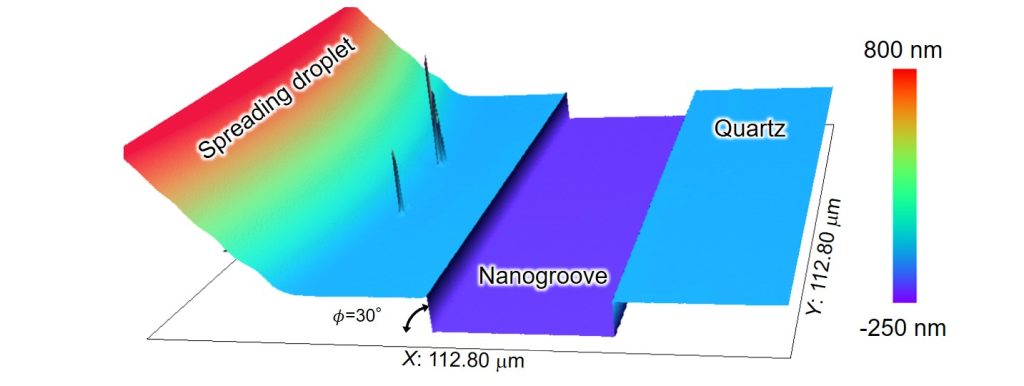
The interaction at material–fluid interfaces can strongly determine device performance, yet many aspects remain unclear and scientifically intriguing. Our interests include energy conversion concepts that utilize charge transport at solid–liquid interfaces, as well as drag reduction strategies that exploit slip and related interfacial flow phenomena.
Through understanding and applying heat and flow phenomena at the nanoscale, we aim to establish knowledge and design principles that significantly improve the performance and reliability of systems and devices, including aerospace vehicles.
We are seeking Ph. D. Students to study in our lab. via Research Assistant System.
News
- May. 2026 A paper mainly conducted by Soma Kato (Alumni) as the first author was published in Thermochimica Acta.
- 2026.05 Assoc. Prof. Li won the Outstanding Young Researcher Award of the Heat Transfer Society of Japan.
- May. 2026 Research by Haruya Ishida (D3), Associate Professor Teshima, and colleagues was published in Nano Letters and announced in a press release.
- Apr. 2026 Associate Professor TESHIMA has been selected for the JST FORESTO program.
- Mar. 2026 A paper mainly conducted by Yuki Ishihara (D1) as the first author has been published in Physical Chemistry Chemical Physics.
- Mar. 2026 A paper mainly conducted by Masumi Misaka (D2) as the first author has been published in International Journal of Heat and Mass Transfer.
- Feb. 2026 A paper mainly conducted by Associate Professor (Special Project) Dawei Li as the first author has been published in AIP Advances.
- Nov. 2025 A paper mainly conducted by Sophie Kimura (Alumni) as a first author has been published in Journal of Applied Physics and was chosen as a Featured Article.
- Oct. 2025 The Significant Contribution Award of the14th Asian Thermophysical Properties Conference(ATPC2025) was awarded to Prof. Koji Takahashi.
- Sep. 2025 A paper mainly conducted by Ryota Saito (D2) as a first author has been published in International Journal of Heat and Mass Transfer.
- Aug. 2025 A paper mainly conducted by Mai Hirakawa (Alumni) has been highly rated and awarded by The Japanese Society for Food Science and Technology.
- May. 2025 Mr. Sung (M2) and Mr. Takiguchi (M2) won the Excellent Presentation Award at the 62nd National Heat Transfer Symposium.
- Apr. 2025 MEMBERS has been updated.
- Dec. 2024 A paper mainly conducted by Yuta Heima (D3) as the first author has been published in Langmuir.
- Dec. 2024 Mr. Ishida (D1) has been selected for JSPS Research Fellowships for Young Scientists (Tokubetsu Kenkyuin) DC2.
- Nov. 2024 A paper mainly conducted by Associate Professor (Special Project) Dawei Li as the first author has been published in International Journal of Mass and Heat Transfer.
- Oct.2024 Mr. Misaka (D1) and Mr. Ishihara (M2) have been selected for JSPS Research Fellowships for Young Scientists (Tokubetsu Kenkyuin) DC2 and DC1, respectively.
- Sep. 2024 A paper mainly conducted by Associate Professor Hideaki Teshima as the first author has been published in Journal of Colloid and Interface Science.
- Aug. 2024 Dr. Dawei LI (Postdoctoral Researcher) has been promoted to Assistant Professor(Special Project).
- Jun. 2024 Ryota SAITO (D1) won the Best Paper Award 2nd Prize at the international conference ACTS2024 held in Shanghai, China. He is the only Japanese recipient.
- Jun. 2024 At the 3rd ACTS2024, Professor TAKAHASHI gave a plenary lecture (The Third Asian Conference on Thermal Sciences @Shanghai).
- Jun. 2024 Assistant Prof. Hideaki TESHIMA has been promoted to Associate Professor.
- Jun. 2024 A paper mainly conducted by Kun CHENG (D3) as the first author has been published in International Journal of Heat and Mass Transfer.
- May. 2024 A paper mainly conducted by Dr. Li (Postdoctoral Researcher) as the first author has been published in Communications Materials.
- May.2024 A paper mainly conducted by Haruya ISHIDA (D1) as the first author has been published in International Journal of Thermofluids.
- APR. 2024 MEMBERS has been updated.
- Mar.2024 A paper mainly conducted by Mai HIRAKAWA (M2) as the first author has been published in Food Science and Technology Research.
- Jan.2024 A paper mainly conducted by Masumi MISAKA (M2) as the first author has been published in Surfaces and Interfaces.
- Dec.2023 The poster presentation conducted by Yuki Ishihara (M1) at the 14th Micro-Nano Engineering Symposium was highly evaluated, and he received the Japan Society of Mechanical Engineers' Micro-Nano Engineering Division's Outstanding Young Presentation Award.
- Dec.2023 A paper mainly conducted by Associate Professor Qinyi Li as the first author has been published in Applied Physics Letters.
- Nov.2023 Dr. Li(Postdoctoral Researcher) won Young Researcher Award of the Japan Society of Thermophysical Properties.
- OCT.2023 Mr. Heima (D2) has been offered a position as a JSPS Research Fellowships for Young Scientists (Tokubetsu Kenkyuin) DC2.
- SEP.2023 Assistant Professor TESHIMA has been selected for the JST PRESTO program.
- Jun.2023 The Joint Student Workshop 2023 with National Central University, Taiwan will be held in July.
- APR. 2023 MEMBERS has been updated.
- APR. 2022 MEMBERS has been updated.
- JUN 2021 The webpage has been updated.
- MAY 2021 Prof. Koji TAKAHASHI & Associate Prof. Qin-Yi LI won the Best Academic Award at the Japan Society of Thermophysical Properties.
- MAY 2021 Assistant Prof. Hideaki TESHIMA won the Excellent Presentation Award at the 58th Japan Society of Thermophysical Properties.
- MAY 2021 Assistant Prof. Qin-Yi LI has been promoted to Associate Professor.
- APR 2021 Dr Hideaki TESHIMA has been appointed as Assistant Professor.